Percentage of Trump Supporters Wh Would Vote for Him Again?
Donald Trump one time famously boasted he could shoot someone on Fifth Avenue, and not lose supporters. For years that seemed true.
But his latest deportment – including the deployment of an ad hoc paramilitary strength against protesters on avenues around the state – may have been too much.
New polls show Trump's support is slipping among key groups, some showing him at a double-digit disadvantage to Autonomous rival Joe Biden.
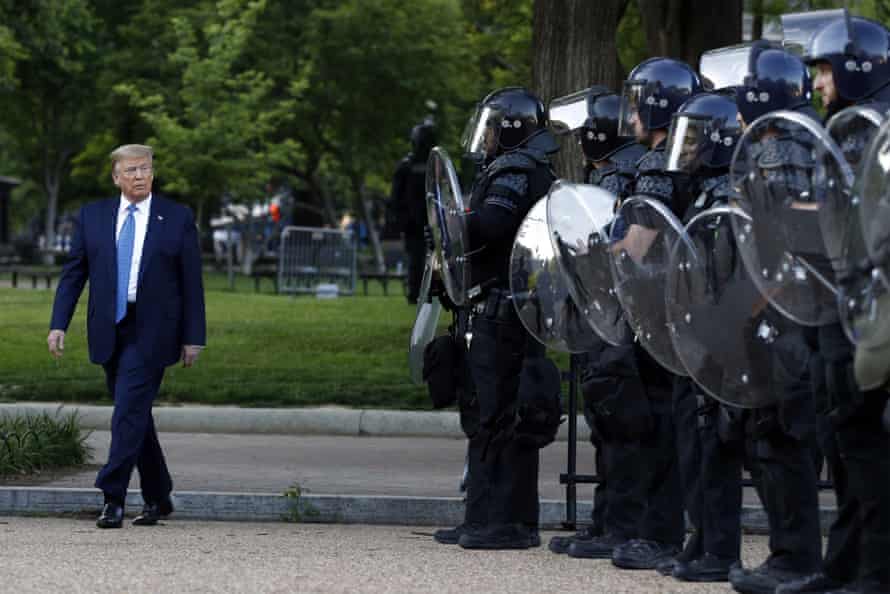
Last Monday night, law and soldiers violently cleared protesters so Trump could walk from the White House to St John's church for a photo opportunity. At that moment, Nolan Fuzzell had seen plenty.
Fuzzell is a table server at a restaurant in Lawrence, Kansas, and previously supported Trump. Just after the photo stunt he tweeted: "Beginning to regret wearing all Trump gear on Election Day 2016. This is not right, on any level."
Then how did Trump lose supporters like Fuzzell, and are they gone for expert?
It's helpful to remember, first, what the president has asked of Republicans. He has treated the party like Theseus'south ancient send, replacing one plank at a fourth dimension until it becomes unrecognizable as itself. From a party whose elites sought to reject Trump in 2016, it has now become virtually unerringly loyal and much inverse.
Under Trump'south leadership, Republicans have gone to state of war against their traditional allies, the FBI. They have cozied up to their quondam opponents, in Russia. Republican leaders have signed off on federal deficits so gargantuan – this year it volition summit a trillion dollars – they would make Franklin D Roosevelt blush.
Trump adherents accept had to boycott the reddest of American sports, professional football.
Towering Republican heroes – political like Mitt Romney, armed services similar John Kelly, both like John McCain – accept come under Trump'due south withering attack.
Trump'due south own former defense secretary, James Mattis, felt compelled to speak out against the treatment of American citizens during protests following the expiry of George Floyd at the hands of police. Comparison the president to Nazi propagandists, Mattis wrote: "We must refuse and concord accountable those in office who would brand a mockery of our constitution."
Among other things Trump has asked evangelical Christians, his staunchest allies, to overlook lurid descriptions of his sexual escapades, hush money paid to a porn actor and – with difficulty – the abandonment of vulnerable Christian communities in northern Syrian arab republic.
Merely the most hard need of Trump's followers is unfolding now.
For years, activists on the right railed against the possibility of US military deployment within the state's borders. A conspiracy theory about such a programme – chosen "Jade Captain 15" – grew so determined that in 2015 Texas senator Ted Cruz requested an explanation from the Pentagon. It was a figment of the fevered rightwing imagination.
Simply at present, under Trump, the American self-invasion is coming truthful: squads of troops from agencies that normally oversee prisons, borders and drug enforcement have taken to the streets, often with no identifying insignia, to tamp downward protests and riots. This week, active-duty troops mustered outside Washington, pending Trump'south command.
The troop build-up alarmed Mattis, a retired marine general.
"Militarizing our response, as nosotros witnessed in Washington DC, sets up a conflict – a faux conflict – between the armed forces and civilian society," he wrote. "It erodes the moral ground that ensures a trusted bail between men and women in uniform and the society they are sworn to protect, and of which they themselves are a part."
All these circumstances have converged to fleck away at Trump's previously granite-hard base of operations.
Fuzzell, the regretful waiter in Kansas, is not alone.
"If I were a Republican operative, I'd be concerned most some of these numbers," said Natalie Jackson, director of enquiry at the Public Organized religion Research Found (PRRI).
PRRI's latest poll shows Trump with an eleven-point deficit to Biden. And underneath that margin, Jackson said, in that location are some previously unseen trends. For example, 47% of white voters with no college degree saw Trump favorably.
"That'south an all-time low," Jackson said. In 2019 that rating had averaged 52%. "It'southward statistically significant."
Much of the drop may be because those not-degreed white voters – Trump's hard core – have suffered mightily during the coronavirus outbreak.
"They are more than probable to work in the service manufacture, and are losing jobs at a higher rate, or going to work at a significant risk to their health," Jackson said.
It'due south hard to know, yet, how the current civil unrest may touch Trump'due south support. But the initial signs are not in his favor. PRRI researchers nerveless their data around the country betwixt May 26 and 31. Midway through that bridge, protests reached an inflection point when rioters burned downward the Minneapolis police'southward 3rd precinct building.
And so the researchers, curious virtually the protests' effect, divided their polling into pre- and post-precinct-burning samples. Amongst all Republicans, Jackson said, Trump's favorability dropped a whopping ix% later on the precinct burn down, from 88% to 79%.
Republican leaders have not turned against Trump, largely, simply they have fallen silent. Later Trump's photo with a Bible outside St John's, senators Mike Enzi of Wyoming and Rob Portman of Ohio told NBC, separately, they couldn't comment considering they were "tardily for lunch".
Senate bulk leader Mitch McConnell, of Kentucky, said he didn't want to "critique other people'due south performances".
Cruz did offer criticism, of a sort. He leveled charges of abuse of power: "Past the protesters, yes."
But other Republican leaders, those who have less to fear from Trump, have begun to denounce him. The terminal Republican president, George Westward Bush, sided with the protesters with a clear reference to Trump. He wrote: "The only manner to see ourselves in a true calorie-free is to listen to the voices of and then many who are hurting and grieving. Those who set out to silence those voices practise not understand the meaning of America – or how it becomes a improve identify."
Senator Manus Romney, of Utah, said in a statement: "From the news clips I have seen, the protesters across from the White House were orderly and nonviolent. They should not have been removed by strength and without warning, specially when the apparent purpose was to phase a photo op."
One voter, who requested anonymity due to threats, wrote in a bulletin: "Considering how far right the Trumpublican political party has moved, I'g now considered left."
And then he started a Facebook folio, directly titled I Regret Voting for Donald Trump in 2016.
"Many are afraid of posting in public due to fears of being attacked by unforgiving people on the left," the voter said.
But his page has 8,600 followers at present.
Source: https://www.theguardian.com/us-news/2020/jun/09/the-trump-supporters-who-regret-their-vote
0 Response to "Percentage of Trump Supporters Wh Would Vote for Him Again?"
Post a Comment